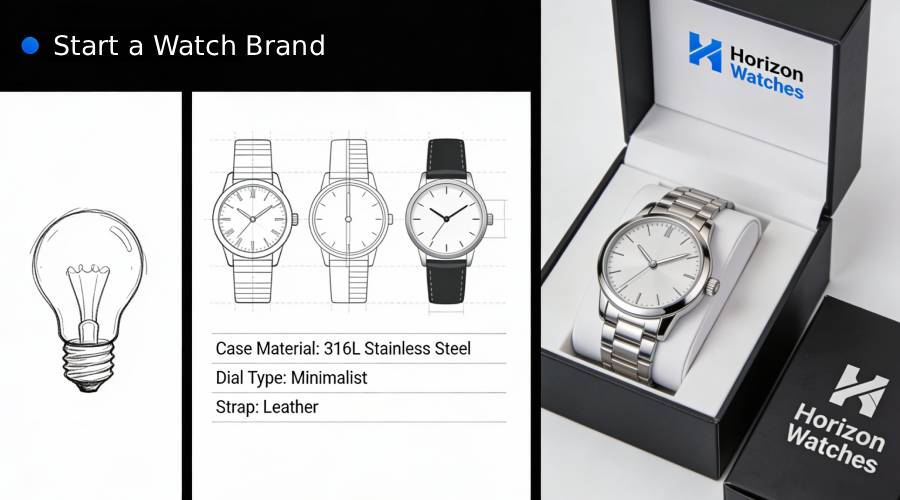
Why Planning Your Watch Brand Comes First
Starting a watch brand has never been more accessible. Online communities, affordable manufacturing, and global shipping make it possible for individual founders and small teams to bring serious timepieces to market—not just fashion accessories with a logo printed on the dial. Yet this new freedom also creates a common problem: many new brands jump into design and sampling without a clear plan, and end up with watches that look like everyone else’s, exceed their budget, or fail to connect with a specific audience.
Before you choose a movement, case material, or dial color, you need to answer a more fundamental question: what kind of brand are you building, and who is it really for. A clear brand plan will guide every later decision—from specifications and pricing to marketing and even which OEM manufacturer you choose to partner with. This article will walk you through the first stage of the journey: turning a rough idea into a structured brand concept you can confidently present to a watch factory.
Step 1: Define Your Target Audience
The first step in starting a watch brand is not choosing a design—it is choosing your wearer. Different audiences have very different expectations for size, durability, style, and price, and understanding them early prevents costly redesigns later.
You can start by asking a few simple questions:
- Who do you imagine wearing your watch most often.
- In what situations will they wear it—office, business meetings, outdoor adventures, diving, travel, gyms, or formal events.
- What is their main motivation for buying: practicality, status, style, collecting, or gifting.
From there, build a simple customer profile. For example, you might describe your ideal customer like this:
- “Male, 28–40, works in a corporate or tech environment, appreciates engineering and minimal design, wants one everyday watch that looks good in the office but also at dinner.”
Or: - “Female, 25–35, prefers smaller case sizes, values elegance and comfort, uses the watch as both a fashion accessory and a subtle statement of taste.”
You do not need a complex marketing document—one paragraph describing age range, lifestyle, income level, style preference, and buying motivation is enough. The key is clarity. Once you know exactly who you are designing for, decisions about size, water resistance, materials, and even strap options become much more straightforward.

Step 2: Clarify Your Brand Story and Style
Once you know who your watches are for, the next step is to define what your brand should feel like. Two brands can target the same audience but still look and communicate very differently—one might lean into rugged adventure, while the other emphasizes refined minimalism. Your brand story and style create the emotional connection that makes your watches more than just specifications and price points.
A simple way to start is by answering one question: why do you want to create this brand in the first place. Maybe your idea comes from a profession (aviation, diving, engineering, medicine), a passion (motorsport, photography, travel), or a cultural background (your city, region, or heritage). This “origin story” does not need to be dramatic, but it should be authentic and consistent. The same idea should appear on your About page, in your product descriptions, and even in subtle design details on the dial, caseback, or strap.
From there, translate your story into a clear design direction. Are you building:
- A tool watch brand focused on legibility, durability, and functionality.
- A refined dress watch line with slim cases and classic proportions.
- A vintage‑inspired brand that revisits historical designs with modern materials.
- A bold fashion‑forward brand with unusual colors, shapes, and textures.
To keep yourself focused, choose three to five keywords that capture your desired identity—for example: “rugged, functional, modern” or “elegant, minimal, timeless.” These words become a filter for future decisions: if a dial color, hand shape, or strap option does not match those keywords, it probably does not belong in your first collection.
Remember that style is not only about appearance; it also influences how you communicate. A technical, tool‑watch brand might use more engineering language and specifications in its marketing, while an elegant lifestyle brand may emphasize mood, outfits, and occasions instead. When your visual design and written tone support the same story, your brand feels coherent and professional from day one.
Step 3: Choose Your Price Range and Value Positioning
With your audience and brand style defined, the next decision is how much your watches should cost—and what kind of value they should deliver at that price. Price is not just a number; it sends a strong signal about where your brand sits in the market and what customers should expect in terms of materials, movement, finishing, and after‑sales support.
A practical way to start is to place your brand into a broad price band, such as:
- Entry‑level: for example, around 50–150 USD, often focused on accessibility and everyday wear.
- Affordable luxury / microbrand: for example, 150–600 USD, where customers expect solid specifications, good materials, and original design.
- Premium and above: 600 USD and higher, where finishing details, higher‑end movements, and strong storytelling become essential.
These ranges are not strict rules, but they help align your product decisions with realistic customer expectations. For instance, at a true entry‑level price, alloy cases and mineral crystals may be acceptable; in the affordable luxury segment, buyers increasingly expect 316L stainless steel, sapphire crystal, and reputable Japanese movements; in the premium segment, Swiss movements, finer finishing, and more complex complications become more common.
Next, think about your value positioning. Do you want to be known for offering the best possible specifications at a given price, or for delivering exceptional design and brand experience even if your spec sheet is more modest. Both approaches can succeed, but they lead to different decisions. A specification‑driven microbrand might prioritize sapphire crystal, solid steel bracelets, and strong water resistance, while a design‑driven brand may invest more heavily in custom dials, unique case shapes, or special straps.
You can sketch one or two example configurations that match your target price and audience. For example:
- For an “everyday tool watch” aimed at professionals in the 200–400 USD range, you might consider: 40–41 mm 316L stainless steel case, sapphire crystal, Japanese automatic movement, 100–200 m water resistance, and a steel bracelet or hybrid strap.
- For an elegant women’s watch around 150–300 USD, you might choose: 32–36 mm case, slim Japanese quartz movement, polished 316L case, sapphire or high‑quality mineral crystal, and a genuine leather strap with quick‑release spring bars.
As you refine these ideas, remember that pushing the price too low can damage perceived quality, especially for a new brand that has not yet built trust. Customers are often willing to pay a reasonable premium for thoughtful design, reliable movements, and consistent finishing. Later, when you consult with an OEM/ODM manufacturer, a clear price range and value strategy will allow them to recommend the most appropriate movements, materials, and production methods for your brand vision.
Step 4: Plan Your First Product Line (Collection Structure)
Many new founders feel tempted to launch too many models at once—different sizes, different movements, many colors. This often leads to high complexity, high inventory risk, and a diluted brand message. A stronger approach is to start with a focused but well‑structured first collection that clearly expresses your brand identity and serves your core audience.
A practical starting point is to define a small “family” of watches built around a single core design. For example, instead of launching six completely different models, you might create:
- One or two core models that will stay in your catalog long‑term as your main volume sellers.
- One highlight or limited model with a special color, material, or complication that creates excitement and storytelling around your launch.
By sharing the same case design, overall style, and many components, these models keep development and manufacturing more efficient while still giving your customers real choice.
Case size is one of the most important structural decisions. For many modern markets, everyday men’s watches often fall in the 38–42 mm range, while many women’s watches sit roughly between 28–36 mm, with trends shifting slightly by region and style. If your audience includes both men and women, you may consider offering two sizes built on the same design language—for example, a 40 mm model and a 36 mm companion model. If your brand is tightly focused (for example, only tool watches or only dress watches), you might instead choose a single “hero size” that best matches your target customer’s wrist and style.
Color planning is another key part of your first collection. A common strategy is to combine:
- One or two classic colors (such as black, white, blue, or silver) that appeal to a wide audience and work in many situations.
- One distinctive colorway that expresses your brand’s personality—a deep green, sunburst burgundy, champagne, or a more adventurous dial treatment.
This approach lets you keep your launch lineup compact while still giving retailers and customers a sense of variety. Later, as your brand grows, you can add new dial colors, strap options, or limited editions using the same core case and movement platform, rather than starting from zero each time.
Finally, think about future expandability from day one. A well‑planned first case design can support multiple future variations: different dial layouts, bezels, complications, and straps. For example, the same base case could later host a three‑hand model, a date version, and perhaps a GMT or diver variant. When you share this long‑term vision with your OEM/ODM manufacturing partner, they can help you design a platform that is efficient to produce now and flexible to expand later. This not only saves cost in the long run, but also allows your brand to tell a continuous story as new models join the same family.
Step 5: List Your Core Specifications Before Talking to a Factory
By this stage, you should have a clear idea of who your brand is for, how it should look and feel, what price range you are targeting, and how your first collection should be structured. The final step before contacting an OEM/ODM manufacturer is to translate all of that into a simple, practical specification brief. You do not need technical drawings or engineering files yet, but you do need a document that clearly explains what you want to build.
A good starting brief can often fit on a single page and should cover the following areas:
- Target customer and use case
Summarize your ideal wearer and main usage scenario in a few lines: for example, “everyday office and weekend watch for professionals,” “robust dive watch for recreational divers,” or “elegant dress watch for formal occasions.” This gives the factory immediate context for durability, water resistance, and style requirements. - Brand story and style keywords
Include a short paragraph about your brand story and three to five keywords that define your identity—such as “rugged, instrumental, modern” or “minimal, elegant, timeless.” This helps the design and engineering team align details like case shape, dial layout, and finishes with your brand vision. - Target retail price range and quantity
Indicate your expected retail price band and your initial production volume (or at least your desired MOQ range, such as 100, 300, or 500 pieces). Combined with your positioning, this allows the manufacturer to suggest realistic combinations of movements, materials, and features that fit both your budget and your brand image. - Core product structure
Briefly describe how many models you plan for your first launch:- Number of core models.
- Any limited or special editions.
- Whether you plan different sizes for different wrist types or one “hero” size to start.
- Key specifications
At this stage, you do not need to know every technical term, but you should outline your preferences for the main components:- Case: approximate diameter, shape (round, square, tonneau), and material (for example, alloy vs stainless steel vs titanium).
- Movement: quartz or mechanical; Japanese or Swiss; any complications you want (date, GMT, chronograph, moon phase, etc.).
- Crystal: mineral glass or sapphire, and whether anti‑reflective coating is important for your concept.
- Water resistance: a general target, such as “everyday splash resistant,” “100 m for swimming,” or “200 m for a true dive watch.”
- Strap/bracelet: type (steel bracelet, leather strap, rubber, fabric), quick‑release or not, and any special preferences like taper or clasp style.
- Visual and reference examples
If there are existing watches whose size, proportions, or general style you like, you can include them as references—without copying them. A few links or images with notes like “I like the case shape of this watch” or “I like the dial layout of that one” give your manufacturing partner a much clearer starting point.
Once you have this concise brief, your first conversation with a watch factory becomes much more productive. Instead of spending time on very basic questions, you can move directly into feasibility, cost estimation, and development timeline. For manufacturers like Romlicen that specialize in OEM and ODM watch projects, a clear specification overview allows the team to advise you on where to upgrade, where to simplify, and how to balance performance, aesthetics, and budget for your first collection.
What to Do Next
If you have followed these steps, you are already far ahead of most first‑time founders. You now understand who your watches are for, what your brand should stand for, which price range makes sense, how your first collection could look, and which core specifications matter most. Instead of a vague dream, you have a structured concept that can be discussed, refined, and turned into real watches.
The next stage is to translate this concept into a concrete project with timelines, costs, and technical details. This is where partnering with an experienced OEM/ODM watch manufacturer becomes critical. A professional factory can review your ideas, suggest suitable movements and materials, highlight potential risks, and guide you from initial design through sampling and mass production.
If you are ready to take the next step, you can:
- Visit our Start Your Watch Brand page to see how the full process works from idea to finished product.
- Read How Much Does a Custom Watch Cost? to better understand the factors behind pricing and budgeting.
- Explore How to Choose a Reliable OEM Watch Manufacturer in China if you are still comparing partners and want a clear checklist.
With a clear plan and the right manufacturing partner, launching your first watch brand becomes not just possible, but achievable in a structured, professional way.